
Introduction: Why BMI Still Matters (and Why It Confuses People)
BMI, or Body Mass Index, is one of the most commonly used health measurements in the world. Doctors, fitness apps, insurance providers, and online calculators rely on it daily.
Yet many people walk away confused or worried after checking their BMI score.
Is BMI accurate?
Does a higher BMI always mean poor health?
Can a “normal” BMI still hide health risks?
This guide on BMI calculator accuracy explained will help you understand what BMI actually measures, where it falls short, and how to use it wisely without panic or false confidence.
By the end, you’ll know exactly what your BMI score can — and cannot — tell you about your health. 🧠
What Is BMI? A Simple Explanation
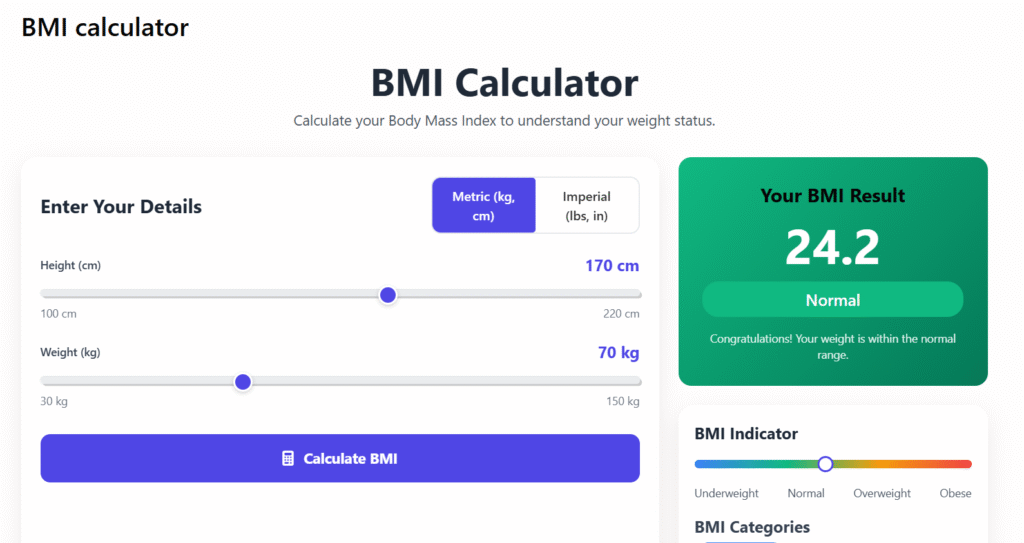
BMI stands for Body Mass Index. It is a numerical value calculated using your height and weight.
BMI Formula
BMI = weight (kg) ÷ height² (m²)
Standard BMI Categories
- Underweight: Below 18.5
- Normal weight: 18.5–24.9
- Overweight: 25–29.9
- Obese: 30 and above
BMI was created as a population-level screening tool, not a diagnostic test. It helps identify weight trends across large groups rather than individual health outcomes.
Why BMI Is Still Widely Used
Despite its flaws, BMI remains popular because it is:
- ✅ Easy to calculate
- ✅ Cost-free
- ✅ Non-invasive
- ✅ Useful for large-scale health studies
Governments and health organizations use BMI because it offers a quick risk snapshot, not a full health picture.
BMI Calculator Accuracy Explained: How Accurate Is It Really?
This is where confusion begins.
The BMI calculator accuracy explained truth is simple:
BMI is moderately accurate for populations but limited for individuals.
What BMI Measures Well
- General weight trends
- Obesity-related risk at a population level
- Screening for potential health concerns
What BMI Does NOT Measure
- Body fat percentage
- Muscle mass
- Bone density
- Fat distribution
- Metabolic health
BMI assumes all weight is equal, which is rarely true.
The Biggest Limitations of BMI
1. BMI Does Not Measure Body Fat
Two people can have the same BMI but very different bodies.
- A muscular athlete may be labeled “overweight”
- A sedentary person may fall in the “normal” range but have high body fat
This makes BMI misleading for muscular individuals.
2. BMI Ignores Fat Distribution
Where fat is stored matters more than how much you weigh.
- Visceral fat (around organs) increases disease risk
- Subcutaneous fat (under the skin) is less harmful
BMI cannot distinguish between the two.
3. BMI Accuracy Varies by Age
As people age:
- Muscle mass decreases
- Fat mass increases
An older adult with a “healthy” BMI may still face metabolic risks.
4. BMI Accuracy Differs by Ethnicity
Research shows BMI thresholds may not apply equally across ethnic groups.
Some populations experience health risks at lower BMI values, while others tolerate higher BMI ranges without the same risks.
What Your BMI Score Really Means
Your BMI score is best viewed as a starting point, not a final judgment.
A “Normal” BMI Does Not Guarantee Health
You may still have:
- High cholesterol
- Insulin resistance
- Low muscle mass
- Poor cardiovascular fitness
This condition is often called “normal-weight obesity.”
A Higher BMI Does Not Always Mean Poor Health
Some individuals with higher BMI values have:
- Healthy blood pressure
- Balanced blood sugar
- Strong cardiovascular fitness
Health is multi-dimensional, and BMI only covers one angle.
BMI vs Body Fat Percentage: Which Is Better?
| Metric | BMI | Body Fat % |
|---|---|---|
| Measures fat directly | ❌ | ✅ |
| Easy to calculate | ✅ | ❌ |
| Accurate for individuals | ❌ | ✅ |
| Useful for screening | ✅ | ✅ |
Body fat percentage gives a clearer picture, but it requires specialized tools.
BMI remains useful when combined with other indicators.
Better Alternatives to BMI for Health Assessment
1. Waist-to-Height Ratio
A strong predictor of heart disease risk.
Rule of thumb:
Your waist should be less than half your height.
2. Waist Circumference
Excess belly fat is strongly linked to metabolic disease.
3. Body Fat Percentage
Measured using:
- Bioelectrical impedance scales
- DEXA scans
- Skinfold calipers
4. Metabolic Health Markers
BMI should never be used alone.
Important markers include:
- Blood pressure
- Blood glucose
- Cholesterol levels
- Physical activity level
Who Should Not Rely on BMI Alone
BMI is less accurate for:
- Athletes and bodybuilders
- Pregnant individuals
- Older adults
- Teenagers and children
- People with high muscle mass
In these cases, BMI may misclassify health risk.
How to Use a BMI Calculator the Smart Way
To use BMI responsibly:
- Treat it as a screening tool, not a diagnosis
- Combine it with waist measurements
- Consider lifestyle and activity level
- Track changes over time, not one result
You can now apply these steps to assess your health more safely and efficiently. 👍
Why BMI Still Has Value in Health Discussions
Despite criticism, BMI remains useful because it:
- Identifies population-level trends
- Helps flag potential risks early
- Encourages further evaluation
The problem isn’t BMI itself — it’s over-reliance on it.
Understanding BMI calculator accuracy explained helps you avoid misinterpretation.
FAQs: BMI Calculator Accuracy Explained
Is BMI outdated?
BMI is not outdated, but it is incomplete. It works best as a screening tool when combined with other health indicators.
Can BMI be wrong?
Yes. BMI can misclassify people with high muscle mass or low muscle mass.
Is BMI accurate for women?
BMI does not account for natural differences in fat distribution, which can affect accuracy for women.
Is BMI accurate for muscular people?
No. Muscular individuals often show higher BMI values without increased health risk.
What is a healthy BMI range?
Generally, 18.5–24.9 is considered healthy, but individual health varies.
Final Verdict: Should You Trust Your BMI Score?
BMI is useful — but only in context.
The key takeaway from BMI calculator accuracy explained is this:
BMI should guide questions, not provide answers.
When combined with lifestyle factors and medical markers, BMI becomes a helpful piece of a much larger health puzzle. 🧩
About the Author
This article was written by a digital content specialist with experience in health-related educational content, data-driven tools, and user-focused web optimization. The goal is to provide clear, practical guidance that helps readers make informed decisions.
Disclaimer
This guide is for educational purposes only. Tool availability and health assessment methods may change over time.